torchbox.ml package
Submodules
torchbox.ml.evolutionary module
- class torchbox.ml.evolutionary.GeneticAlgorithm(pop_size: int = 50, n_gen: int = 100, crossover_prob: float = 0.8, mutate_prob: float = 0.1, elitism: bool = True, elitism_num: int = 2, device: str = 'cpu')
Bases:
ABCGeneric extensible Genetic Algorithm base class implemented in PyTorch Only need to override: initialize_population, crossover, mutate, selection methods Main evolution process is generic and supports GPU acceleration
- abstractmethod crossover(parent1: Tensor, parent2: Tensor) Tensor
[Must override] Crossover operation Input: Two parent individuals (chromosome_length,) Returns: Child individual (chromosome_length,)
- evaluate_fitness(population: Tensor) Tensor
[Optional override] Fitness function (default requires user to override) Input: Population tensor [pop_size, chrom_len] Returns: Fitness tensor [pop_size] (higher value means better individual)
- evolve() Tuple[Tensor, Tensor]
Generic main evolution process (Core! No modification needed) Returns: Best individual, Best fitness history
- abstractmethod initialize_population() Tensor
[Must override] Initialize population Returns: Population tensor (shape: [pop_size, chromosome_length])
torchbox.ml.reduction_pca module
- torchbox.ml.reduction_pca.pca(x, sdim=-2, fdim=-1, npcs='all', eigbkd='svd')
Principal Component Analysis (pca) on raw data
- Parameters:
x (Tensor) – the input data
sdim (int, optional) – the dimension index of sample, by default -2
fdim (int, optional) – the dimension index of feature, by default -1
npcs (int or str, optional) – the number of components, by default
'all'eigbkd (str, optional) – the backend of eigen decomposition,
'svd'(default) or'eig'
- Returns:
U, S, K (if
npcsis integer)- Return type:
tensor
Examples
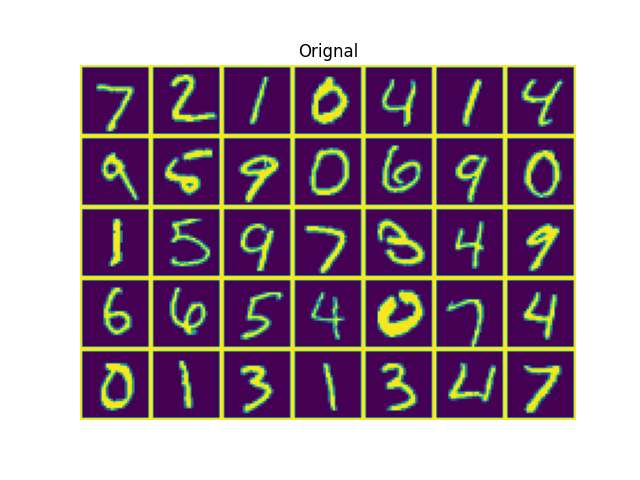
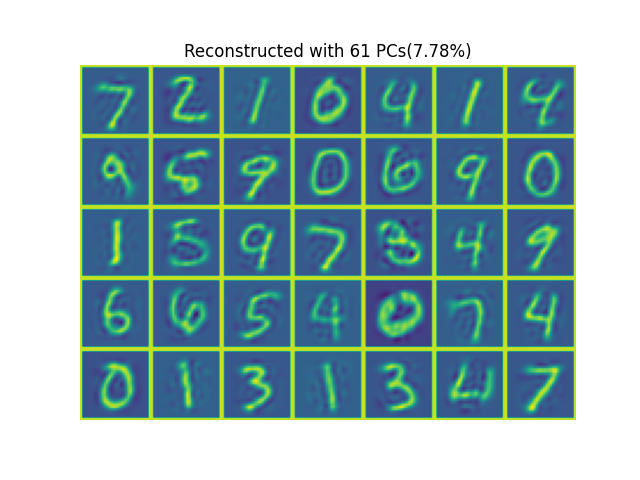
The results shown in the above figure can be obtained by the following codes.
rootdir, dataset = '/mnt/d/DataSets/oi/dgi/mnist/official/', 'test'
x, _ = tb.read_mnist(rootdir=rootdir, dataset=dataset, fmt='ubyte')
print(x.shape)
N, M2, _ = x.shape
x = x.to(th.float32)
pcr = 0.9

u, s = tb.pca(x, sdim=0, fdim=(1, 2), eigbkd='svd')
k = tb.pcapc(s, pcr=pcr)
print(u.shape, s.shape, k)
u = u[..., :k]
y = x.reshape(N, -1) @ u  # N-k
z = y @ u.T.conj()
# z[z<0] = 0
z = z.reshape(N, M2, M2)
print(tb.nmse(x, z, dim=(1, 2)))
xp = th.nn.functional.pad(x[:35], (1, 1, 1, 1, 0, 0), 'constant', 255)
zp = th.nn.functional.pad(z[:35], (1, 1, 1, 1, 0, 0), 'constant', 255)
plt = tb.imshow(tb.patch2tensor(xp, (5*(M2+2), 7*(M2+2)), dim=(1, 2)), titles=['Orignal'])
plt = tb.imshow(tb.patch2tensor(zp, (5*(M2+2), 7*(M2+2)), dim=(1, 2)), titles=['Reconstructed with %d PCs(%.2f%%)' % (k, 100*k/u.shape[0])])
plt.show()

u, s = tb.pca(x.reshape(N, -1), sdim=0, fdim=1, npcs=2, eigbkd='svd')
print(u.shape, s.shape)
y = x.reshape(N, -1) @ u  # N-k
z = y @ u.T.conj()
z = z.reshape(N, M2, M2)
print(tb.nmse(x, z, dim=(1, 2)))
- torchbox.ml.reduction_pca.pcapc(s, pcr=0.9)
get principal component according to the ratio of variance
- Parameters:
s (Tensor) – eigenvalues
pcr (float, optional) – the ratio of variance, by default 0.9
- torchbox.ml.reduction_pca.pcat(x, sdim=-2, fdim=-1, isnorm=True, eigbkd='svd')
gets Principal Component Analysis transformation
- Parameters:
x (Tensor) – the input data
sdim (int, optional) – the dimension index of sample, by default -2
fdim (int or tuple, optional) – the dimension index of feature, by default -1
isnorm (bool, optional) – whether to normalize covariance matric with the number of samples, by default True
eigbkd (str, optional) – the backend of eigen decomposition,
'svd'(default) or'eig'
- Returns:
the PCA transformation matrix, the eigenvalues
- Return type:
tensor